


How Melodic Minor Actually Works
Students are taught that the scale changes as it moves up or down. Jake Lizzio and Levi Clay demonstrate that's just wrong!
By Jake Lizzio · Signals Music Studio · 700,000+ subscribers on YouTube
Like countless other music students, I was taught about the melodic minor scale by teachers who repeated the following description:
When you ascend through melodic minor, it's a minor scale but you raise the 6th and 7th. When you descend, it's the natural minor scale.
I think you should throw away this description. To learn why, Levi Clay and I will explore how and why the melodic minor scale actually gets used, using real-world examples.
Get The Jam Tracks For Free!
Practice using the A Melodic Minor Scale over different chords in two different styles: dramatic prog rock, and jazz.
Get The Free DownloadWhat Is Melodic Minor?
The melodic minor scale is a minor scale with a raised 6th and 7th, regardless of what direction you're moving.
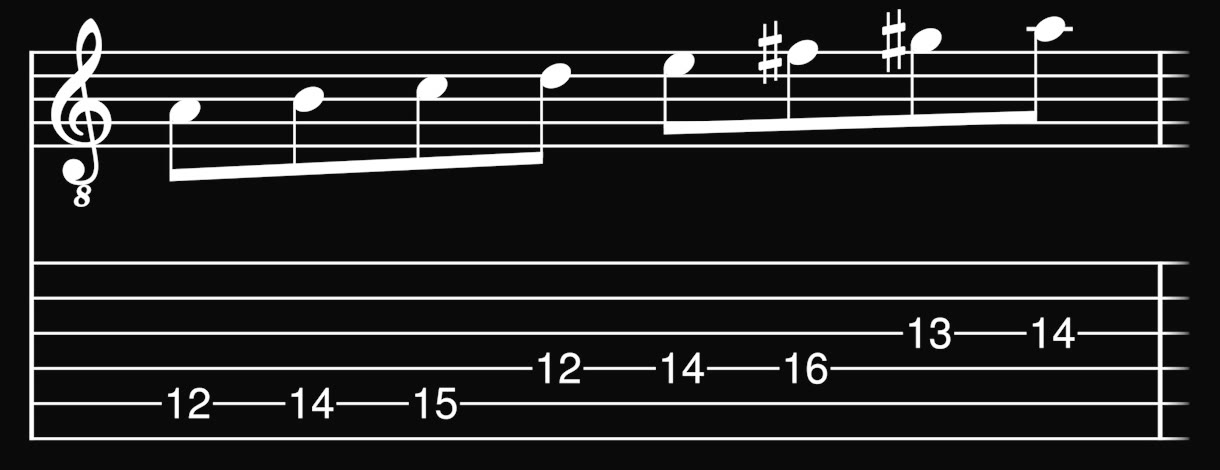
In A, that's A - B - C - D - E - F# - G# - A, or scale degrees 1 - 2 - b3 - 4 - 5 - 6 - 7. You might think of that as a major scale with a flat third, but as Levi will demonstrate, it's helpful to think of it as Dorian with a raised 7th.
You'll also hear this set of notes called "Jazz Minor" or "Ascending Melodic Minor." However, as we'll see, this scale really does not have a directional component to it.
Where Do We Hear Melodic Minor?
You'll most commonly hear this scale used on top of the dominant chord (V7) in minor keys, just like how harmonic minor is commonly used.
The raised 7th is the leading tone, a half step below the root, which gives the V chord its strong pull back home. Raising the 6th as well smooths out the awkward gap (an augmented 2nd) between the b6 and the 7 that you hear in harmonic minor.
For example, in "Shchedryk," better known as "Carol of the Bells," we see the notes of the A natural minor scale. Then over the dominant chord (E), the A melodic minor scale appears instead.
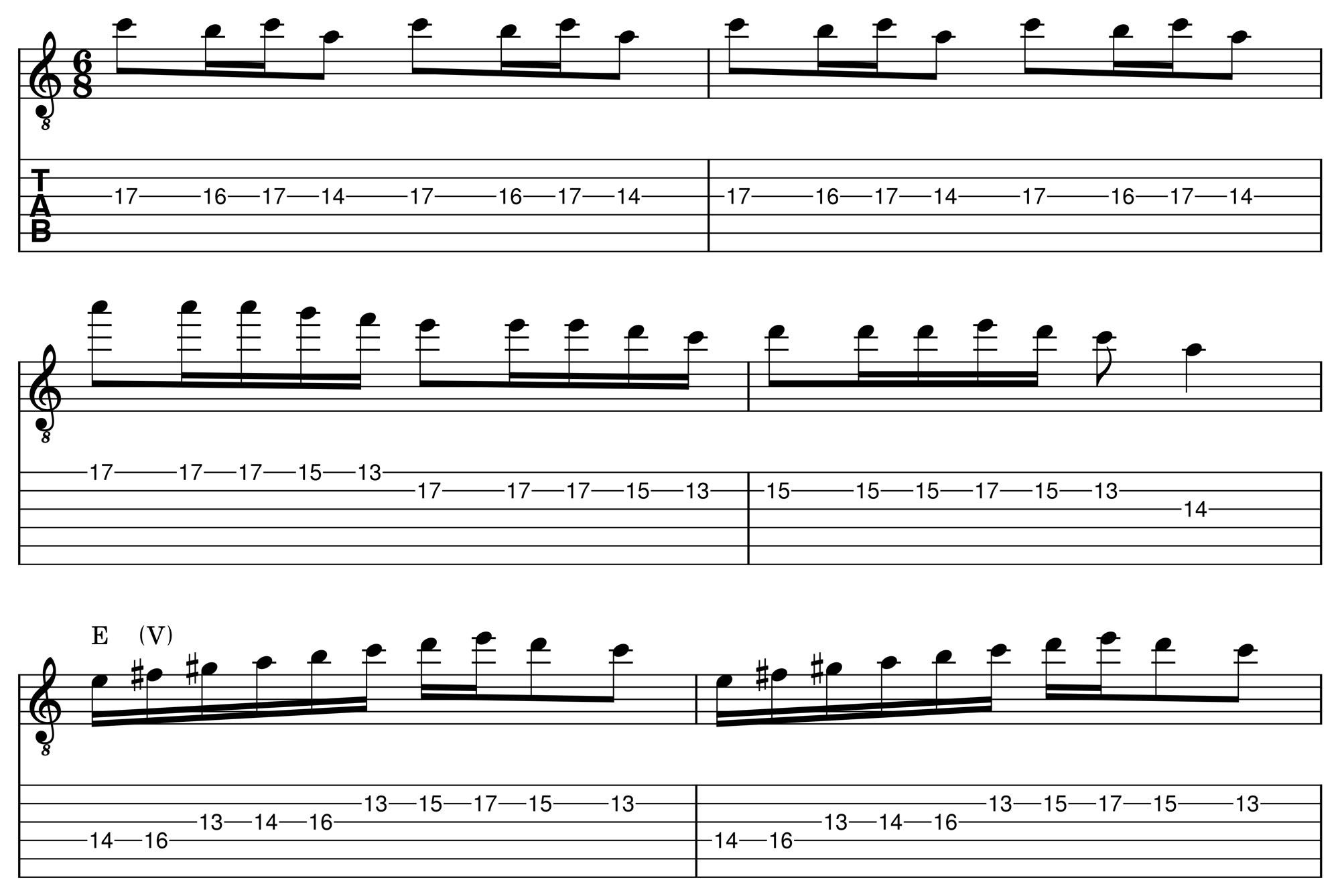
"Being for the Benefit of Mr. Kite!" by The Beatles starts right off with a progression in D minor:
Over that dominant chord of A or A7, you'll consistently hear the melodic minor scale. This happens several times throughout the song, and even in different keys as the song modulates.
How NOT to Use Melodic Minor
I don't like handing out rules, but I do have a suggestion: don't try to compose music that is "in" melodic minor and has a tonal center around its root note. You'll probably never encounter any music that behaves like that, simply because it creates a fairly clumsy sound.
However, harmonizing melodic minor into modes is quite popular, and a must-know technique in my opinion. Two of its modes are jazz staples: Lydian dominant, built on the 4th degree, and the altered scale, built on the 7th. The modes of melodic minor are a topic I explore in my book, The Chord Progression Codex.
The Relative Melodic Minor
When you're composing in major, consider your relative minor key and how it might transform into melodic minor. This can give you interesting chords and melodies to weave into your major compositions.
For example: G major is relative to E minor (same notes, same chords). When composing in G, consider E melodic minor's offerings instead: not just its notes, but its chords.
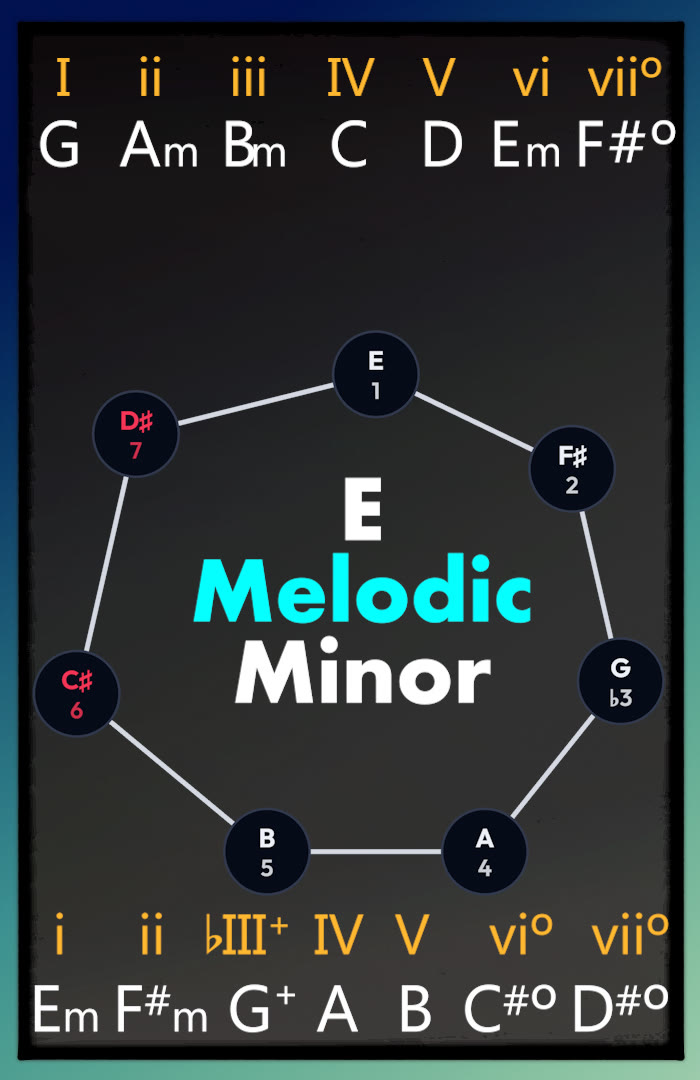
This is what you'll see at the beginning of "Yesterday" by The Beatles. We begin with a G chord, but then see a ii - V - i using E melodic minor. And over that sequence, we hear the E melodic minor scale in the sung melody:
Mixolydian b6 or Melodic Minor?
If you write out the notes of the A melodic minor scale, but start on the fifth note, you'll end up with a scale called E Mixolydian b6.
In the key of Am, some players and teachers will see the dominant chord (E) and think "Here's a good place to play E Mixolydian b6," while others will say "We're changing into A Melodic Minor." They're both accomplishing the same thing.
E Mixolydian b6 is a mode of melodic minor. Future lessons will explore the practicality of these modes, but they're covered in my book.
Melodies Tend to Ascend
In these examples, you will notice that the melodic minor phrases do move in an upward direction over the dominant chord. Then, after that tension has resolved, the 6th and 7th often get lowered to their natural minor state.
These are simply tendencies though, and not rules!
Why the Ascending/Descending Rule Is Bunk
If you need some good, solid evidence for why the ascending/descending rule is ignorable, you can find it in Sharon Towndrow's 1977 thesis on this exact topic. Inside, you'll find many examples of Bach's work that show clear violations of this concept.
You can also just use your ears. Compose a quick i - V - i in a minor key, and experiment with melodic minor in both directions over the dominant. It sounds fine!
The Jazz Perspective
As Levi demonstrates in the lesson, melodic minor is a powerful scale to improvise with. Instead of reserving it for the dominant chord, you can use it over the tonic to create a more intriguing sound.
Importantly, this scale even works over a m7 chord, which by nature uses a b7. The clash between the chord's b7 and the scale's natural 7th can be a disaster when sustained for too long, or in the wrong moments, but it can also provide a potent jazz flavor when done quickly and with intention.
Making Original Music with Melodic Minor
To demonstrate these concepts in the real world, I teamed up with Levi to write a short piece of music. It all revolves around the following chord progression:
I was thinking about the A minor scale when I wrote those first two chords (they're just i and bVI). Then I thought about raising the 6th note to F#, which creates A Dorian and allows me to build that F#m7b5 chord. Lastly, I envisioned raising the 7th as well, to create A melodic minor and build a dominant chord.
You'll see that over the F chord, Levi avoids playing an F# and sticks mostly to Aeolian or minor pentatonic. But his improvisation includes flashes of melodic minor across all the other chords.
More Scale Mixture
If you're interested in writing music with these kinds of ideas in mind, you may enjoy my masterclass on modal mixture and scale combinations. It's 6 weeks of videos, slides, and assignments, available for all premium members.
Levi Clay
If you're interested in learning more from Levi, check out his site, Guided Practice Routines, or his YouTube channel. He's a transcription pro, but also teaches high-level improvising concepts for modern jazz and fusion players.